

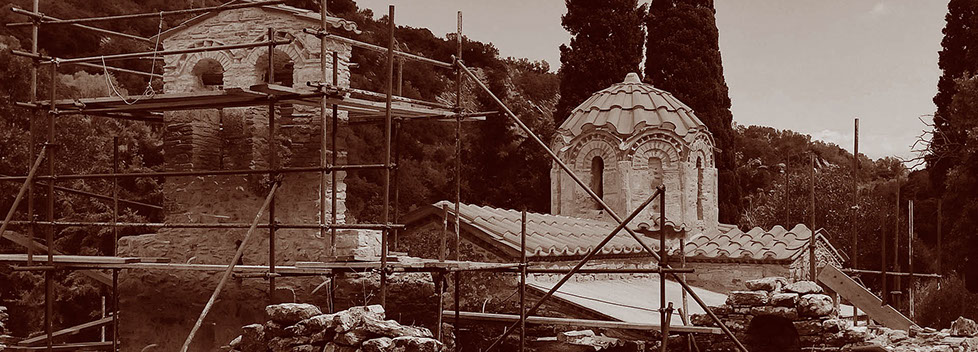
Holy Monastery of Panagia Grivitsiani
Title:
Restoration of the Katholikon of the Holy Monastery of Panagia Grivitsiani, Regional Unit of Messenia
Region:
Peloponnese, Regional Unit of Messenia, Municipality of Koroni
Operational Programme:
“Peloponnese 2014–2020”

Implementing Authority:
Ephorate of Antiquities of Messenia
Budget:
€300,000.00
Fund:
European Regional Development Fund (ERDF)
Description:
The aim of this project was the restoration of the katholikon of the Holy Monastery of Panagia Grivitsiani, which forms part of a larger complex of monastic buildings enclosed within a rectangular fortified precinct.
The katholikon, whose initial construction phase dates to the late 12th or early 13th century AD, is a two-columned cross-in-square church with later additions and alterations. It is adorned with significant wall paintings of the 16th–17th centuries AD, representing important examples of post-Byzantine religious art.
Within the framework of the project, an archaeological investigation was carried out along the southern and eastern sides of the katholikon, revealing architectural and burial remains. Restoration and morphological rehabilitation works included:
-
Consolidation and repair of masonry and vaults,
-
Roof reconstruction and tiling,
-
Installation of wooden doors, windows, and a new iconostasis,
-
Conservation of wall paintings, with immediate emergency stabilization measures, and
-
Landscaping of the surrounding area to ensure accessibility and protection of the monument.
Benefits:
The completion of the project and the elimination of structural and conservation issues have highlighted the historical and architectural value of the katholikon. The restored monument now ensures safe visitor access and contributes to the preservation and promotion of the area’s cultural heritage.
All interventions were fully recorded, and all archaeological finds were documented in detail. The monument’s interpretation and public presentation have been enhanced through visitor information measures and dissemination of the project’s results to the scientific community.
The promotion of this emblematic monument, set in an area of outstanding natural beauty, contributes to increased visitation, the development of cultural tourism, and the revitalization of local entrepreneurship, thus fostering the overall development of the region.
The project was completed on 26 December 2022.